Wednesday, September 14, 2011

limited good

* A couple sentences tweaked 12:44am September 14, 2011

This essay by Christopher Newfield (Remaking the University; Unmaking the Public University) has stuck with me since I first encountered it in early August, in the throes of the debt ceiling "crisis." Especially this paragraph:
In reality, our extreme inequality is extremely unpopular, nearly as much on the right as on the left. But once the banana republic has been established, low taxes make individual sense, and in the U.S. they function as a kind of political booby prize. With the stock and housing booms over, most people feel they can't increase their own incomes through known legal means, and since virtually no one thinks they can make America more egalitarian, low taxes on our modest incomes can look like the next best thing.
Newfield's insight here reminds me of the concept of "limited good," which I learned in a weirdly old-fashioned, out-of-touch Anthropology course in college. LG is a world view ascribed by Western anthropologists to non-industrialized societies, as Wikipedia helpfully explains:
The term limited good is a concept from anthropology describing the theory commonly held in traditional societies, that there is a limited amount of "good" to go around. In other words, the amount of good luck, money, etc. available is held to be finite, so every time one person profits, another loses. Societies that subscribe to this philosophy tend to display strong levels of equality among members and to be strongly resistant to social change.
The term was coined by George M. Foster in his 1965 article, Peasant Society and the Image of Limited Good, "American Anthropologist." [Original punctuation and syntax - i.e., don't blame me!] The concept has been described by [Tim] Allen as the rural counterpart of the culture of poverty. The Mexican peasants (in Tzintzuntzan, Michoacán) Foster studied were seen by him to lack interest in new opportunities because of their perception of the word as a "competitive game." This led to a high level of distrust and envy and fragile and constantly shifting patterns of alignment.
This seems to me an ironically, uncannily prophetic description of Tea Party America: A "traditional society" "resistant to social change," beset by record poverty rates and a "see no evil" political culture. Thus goes the right-wing self-destruct pact: with so little hope of making America more egalitarian, let's make sure it's as unequal as possible. If we can't have equality, then no one can.

Saturday, June 18, 2011

totem animals

Over at Village Dog ( scroll view | mosaic view ) I've been keeping a list of "totem animals" - kind of a journal in animal images, or animal avatars perhaps. The idea came from the late great Eve Kosofsky Sedgwick, who would start off a seminar by asking students to take turns naming their "totem animals," and going around the room reciting each other's totems. I had the privilege of taking my very first graduate course with Eve in the olden days. My totem that day was completely uninspired - I think I just said my Chinese zodiac sign. So this is my attempt to do better. Another day (or two, or three), another ice-breaker.

Here are a few recent entries (strange that sleeping and sound technology seem to be on my mind lately):
#68: Lucian Freud, Eli


#67: Todd Baxter, Fox on Reel to Reels (toile pattern based on photograph)
#65: Charles Dury, young grizzly cub born in Cincinati Zoo, 1870s
#62: Toadfish, from the Reanimation Library visual archive
All 68, altogether.

Friday, June 10, 2011

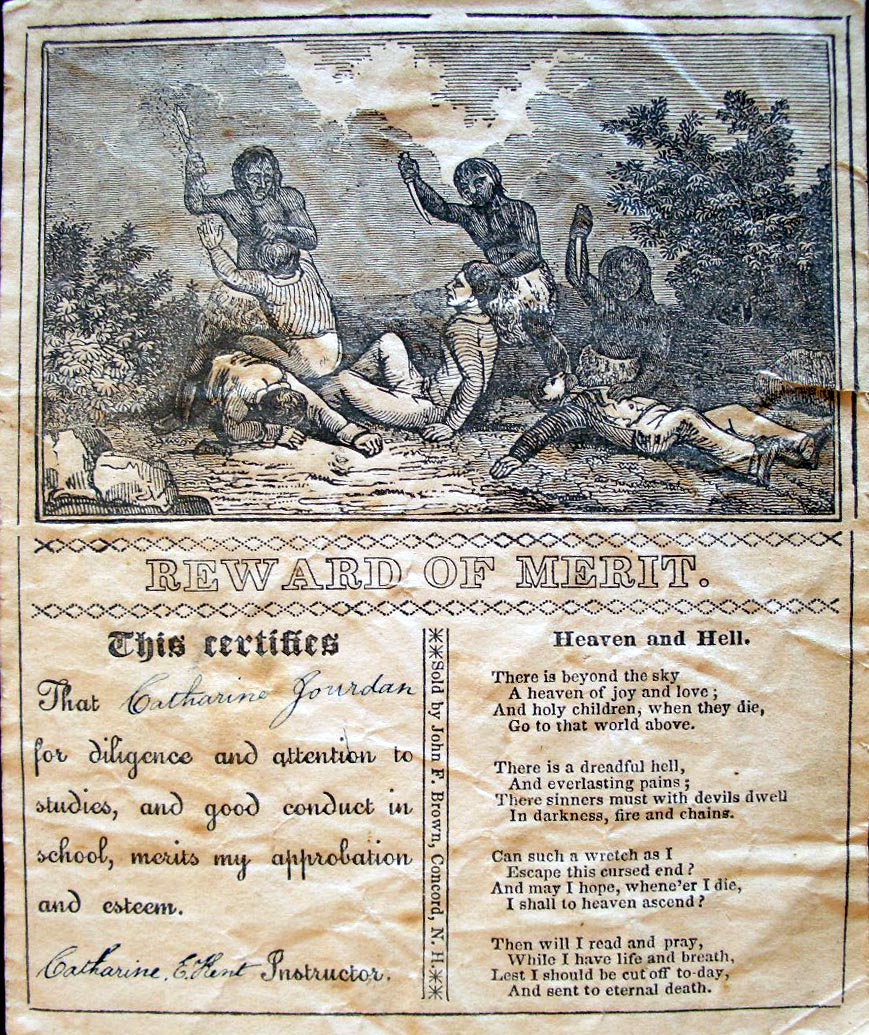
gold star for settler colonialist paranoia

American culture really hurts my brain sometimes. Imagine poor Catherine Jourdan getting this as a reward for her academic labor.

From Princeton Library's collection of Awards of Merits from the 1820s onward - not sure exactly of the date for this one. Less pedagogically twisted examples here.

Saturday, June 4, 2011

flipper, we are not in san diego anymore

Another military animal story: this time a photo essay at Mother Jones. Some of the images are quite surreal. As is the final quote in the caption below. I guess we all have different opinions of what San Diego is like?

"like ghosts, dogs are enigmas"

I'm posting what I hope will be the first of a few passages from Colin Dayan's engrossing new book The Law is a White Dog (chapter 1 available for download).

Dayan's dogs are quite a different lot from the flak-jacketed K9's that have been in the news of late, or the progressive modern pets that grace the pages of the Bark. In this book we find dogs in the company of slaves, prisoners, and detainees - "extraneous persons" on the precipice between being subjects and being nothing. Here we find canis familiaris outside the ideological safe house of sentimental (or, for that matter, military) domesticity...
Howling through the shadows at Hecate’s crossroads, sitting at Pontius Pilate’s feet, snarling at Jesus crucified, or accompanying the souls of the dead to the other side, dogs inhabit both divine and demonic realms. Like ghosts, dogs are enigmas. So speaks Nietzsche’s Zarathustra, haunted by his own thoughts:

Then, suddenly, I heard a dog howl nearby.
Had I ever heard a dog howl like this? My thoughts raced back. Yes! When I was a child, in my most distant childhood:
—then did I hear a dog howl like this. And I saw it too, bristling, its head up, trembling in the stillest midnight when even dogs believe in ghosts.


Ghosts like dogs are drawn to the familiar, the everyday, even as they tend toward the paranormal and supernatural. They appear as if somewhere between the real and supernatural, returning as a nightmare white phantom, a silent shade, or heavy with flesh, overripe and in need. In the meeting of the actual and the imaginary, ghosts and dogs bear down on the world of social relations and morality. Dogs and ghosts constantly cross boundaries, visit what they coveted most in life, counting on the heaviness of things to give them pleasure, to make them grieve. Ultimately, no matter how much they suggest the impalpable or transcendent, ghosts always come in bodies. They never obey the command to be wisps of air, some kind of steam, wet in the night or voices on the wind. (pp 15-16)
See also: this previous post on pit bulls and Dayan's essay "The Dogs"

Monday, May 30, 2011

war animals, finny and furry

A while ago I started a "military animal" bibliography on Zotero to share with a friend who's also interested in the social and cultural studies of dogs. It's definitely dog-heavy, though crows and camels also put in cameos. Most of the items are news stories from the past few years (lots of Bin Laden commando dog stuff of late). Here are a couple gems I've added recently. The first is more humorous ephemera, the latter, less so.

i. WWII submarine insignia
Via All My Eyes: "Due to the stealth nature of submarines, a logo is not displayed on the vessel itself, but it is printed on stationery, made into jacket patches, mess hall items, and home-port flags."


ii. K-9 Storm
Via Amaki09's Tumblr (click images for direct links). Google K9 Storm for more.

Monday, May 23, 2011

the weirdest people in the world?


WEIRD as in Western, Educated, Industrialized, Rich, Democratic.

I'm so excited about this acronym, I'll readily admit to not having read the source article yet! Here's the abstract by psychologists Joe Henrich, Steven J. Heine, and Ara Norenzayan of the University of British Columbia:
Behavioral scientists routinely publish broad claims about human psychology and behavior in the world’s top journals based on samples drawn entirely from Western, Educated, Industrialized, Rich and Democratic (WEIRD) societies. Researchers - often implicitly - assume that either there is little variation across human populations, or that these “standard subjects” are as representative of the species as any other population. Are these assumptions justified? Here, our review of the comparative database from across the behavioral sciences suggests both that there is substantial variability in experimental results across populations and that WEIRD subjects are particularly unusual compared with the rest of the species - frequent outliers. The domains reviewed include visual perception, fairness, cooperation, spatial reasoning, categorization and inferential induction, moral reasoning, reasoning styles, self-concepts and related motivations, and the heritability of IQ. The findings suggest that members of WEIRD societies, including young children, are among the least representative populations one could find for generalizing about humans. Many of these findings involve domains that are associated with fundamental aspects of psychology, motivation, and behavior - hence, there are no obvious a priori grounds for claiming that a particular behavioral phenomenon is universal based on sampling from a single subpopulation. Overall, these empirical patterns suggests that we need to be less cavalier in addressing questions of human nature on the basis of data drawn from this particularly thin, and rather unusual, slice of humanity. We close by proposing ways to structurally re‐organize the behavioral sciences to best tackle these challenges.
Found via Andrew Goldstone's "Race, Ethnicity, Brains" - which is in turn a response to this really intriguing "fairy tale" on cultural neuroscience by Paula Moya. Goldstone and Moya both teach at Stanford.

* Image: inspired illustration of Henrich, Heine, Norenzayan's research by Only Dead Fish.