Thursday, May 19, 2011

fear of a black senate; or, birtherism, 1868

From Princeton's Graphic Arts blog:
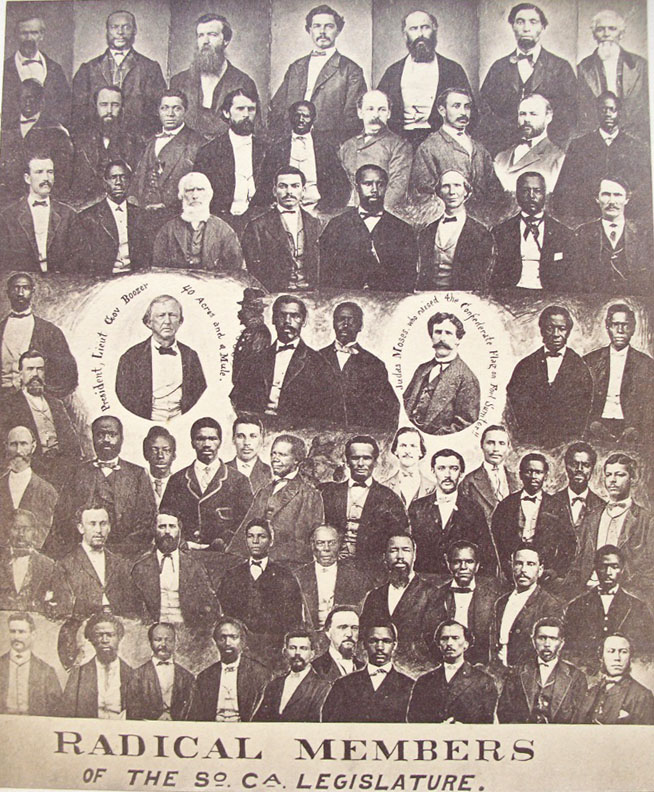
The composite image [racist text not shown - quoted below] documents the implementation of the Reconstruction Act of 1867, which redesigned the governing bodies of the southern states after the American Civil War. Not only did African Americans have the right to vote, but also serve within the government. When South Carolina rejoined the Union in 1868, they had the first state legislature with a black majority.

Created to frighten the white population, this image was widely distributed in many sizes and formats. One of our copies includes the text: These are the photographs of 63 members of the reconstructed South Carolina Legislature, 50 of whom are negroes or mulattoes and 13 white. 22 read and write (8 grammatically), the remainder (41) make their mark with the aid of an amanuensis. Nineteen (19) are tax-payers to an aggregate amount of $146.10, the rest (44) pay no taxes, and the body levies on the white people of the State for $4,000.00.

Wednesday, May 18, 2011

quick notes: deadly dualisms

Kim TallBear, opening comments at the "Why the Animal? Queer Animalities, Indigenous Naturecultures, and Critical Race Approaches to Animal Studies" symposium (April 12th, 2011):
[The symposium speakers'] critical approaches make the link between dualisms and the relegation of certain humans to the realm of less-than-human, to the realm of the animal. Violence against animals is linked to violence against particular humans who have historically been linked to animality. There are real implications... for who and what gets to live, and who and what gets to die when the human/animal split is made.

Tuesday, May 17, 2011

being hunted

{ I }
Val Plumwood, "Being Prey," 1995 (reprinted in the Utne Reader as "Surviving a Crocodile Attack" in 2000)*:
It seems to me that in the human supremacist culture of the West there is a strong effort to deny that we humans are also animals positioned in the food chain. This denial that we ourselves are food for others is reflected in many aspects of our death and burial practices—the strong coffin, conventionally buried well below the level of soil fauna activity, and the slab over the grave to prevent any other thing from digging us up, keeps the Western human body from becoming food for other species. Horror movies and stories also reflect this deep-seated dread of becoming food for other forms of life: Horror is the wormy corpse, vampires sucking blood, and alien monsters eating humans. Horror and outrage usually greet stories of other species eating humans. Even being nibbled by leeches, sand flies, and mosquitoes can stir various levels of hysteria.
This concept of human identity positions humans outside and above the food chain, not as part of the feast in a chain of reciprocity but as external manipulators and masters of it: Animals can be our food, but we can never be their food. The outrage we experience at the idea of a human being eaten is certainly not what we experience at the idea of animals as food. The idea of human prey threatens the dualistic vision of human mastery in which we humans manipulate nature from outside, as predators but never prey. We may daily consume other animals by the billions, but we ourselves cannot be food for worms and certainly not meat for crocodiles. This is one reason why we now treat so inhumanely the animals we make our food, for we cannot imagine ourselves similarly positioned as food. We act as if we live in a separate realm of culture in which we are never food, while other animals inhabit a different world of nature in which they are no more than food, and their lives can be utterly distorted in the service of this end.
Before the encounter, it was as if I saw the whole universe as framed by my own narrative, as though the two were joined perfectly and seamlessly together. As my own narrative and the larger story were ripped apart, I glimpsed a shockingly indifferent world in which I had no more significance than any other edible being. The thought, This can't be happening to me, I'm a human being. I am more than just food! was one component of my terminal incredulity. It was a shocking reduction, from a complex human being to a mere piece of meat. Reflection has persuaded me that not just humans but any creature can make the same claim to be more than just food. We are edible, but we are also much more than edible. Respectful, ecological eating must recognize both of these things. I was a vegetarian at the time of my encounter with the crocodile, and remain one today. This is not because I think predation itself is demonic and impure, but because I object to the reduction of animal lives in factory farming systems that treat them as living meat.

{ II }

Not being prey is not always a sure thing for humans - not all humans anyway - in Western history. In New World slavery, for example, one can be meat for animals without necessarily being food. Or perhaps the correct word is flesh? Among other hideous things, racism is a system which has historically made some people's flesh subject to animal violence.

{ III }
Dog bite genealogy: more images along this vein I've been collecting over at Tumblr.

- - -

* Plumwood's memorial website has a Word version of this essay, which is how I first read it. But the file ended up crashing my computer - so avoid it!

publish, perish - or phish

Surprised they didn't ask for your social and bank account number too!

Saturday, April 30, 2011

"you're fired"; or, the grotesque cog of power

Michel Foucault on "grotesque sovereignty" in the West (source):
Political power, at least in some societies, and anyway in our society, can give itself, and has actually given itself, the possibility of conveying its effects and, even more, of finding their source, in a place that is manifestly, explicitly, and readily discredited as odious, despicable, or ridiculous.
This grotesque mechanism of power, or this grotesque cog in the mechanism of power, has a long history in the structures and political functioning of our societies. There are striking examples of it in Roman history, especially in the history of the Roman Empire, where the almost theatrical disqualification of the origin of power in, and the coupling of every effect of power with, the person of the emperor was precisely a mode, if not of governing exactly, at least of domination: a disqualification that ensured that the person who possessed maiestas, that is to say, more power than any other power was, at the same time, in his person, his character, and his physical reality, in his costume, his gestures, his body, his sexuality and his way of life, a despicable, grotesque, and ridiculous individual.
We know that ethnologists... have clearly identified the phenomenon in which the person to whom power is given is at the same time ridiculed or made abject or shown in an unfavorable light, through a number of rites and ceremonies. Is this a case of a ritual for limiting the effects of power in archaic or primitive societies? Perhaps.
However, I would say that if these rituals still exist in our societies, their function is completely different. I do not think that explicitly showing power to be abject, despicable, Ubu-esqu or simply ridiculous is a way of limiting its effects and of magically dethroning the person to whom one gives the crown.
Rather, it seems to me to be a way of giving a striking form of expression to the unavoidability, the inevitability of power, which can function in its full rigor and at the extreme point of its rationality even when in the hands of someone who is effectively discredited.

Wednesday, April 27, 2011

word cloud #2: domestications, multispecies resettlement, barbarians

Another "words (and ideas) that caught my attention" post, apropos of the "origins of human rule" from entry #1 below. Here are the titles of a set of upcoming lectures at Harvard by the the political anthropologist James Scott:
Four Domestications: Fire, Plants, Animals and… Us

The Late Neolithic Multi-Species Resettlement Camp

The Long Golden Age of Barbarians, a.k.a. Non-State Peoples
Which reminds me, I need to read James Scott!

word cloud #1: human rule, before present

Almost everyday I come across interesting turns of phrase or figures of thought that make me pause and think: "oh, I should jot this down somewhere." So I'm going to start collecting them here. This will also double as a public bookmarking system since, more often than not, I won't actually have had the chance to study the source of the phrase yet.

My first two entries are from the "Ghost Metropolis: Los Angeles since 13,000" mapping project at Hypercities. I don't know enough about either to explain what they are, so I won't fake it. But I do plan to read through the "Ghost Metropolis" materials, a crazy ambitious history of (what we now know as) L.A. In the course of skimming through the first couple screens these phrases wormed their way into my brain:

1. The Origins of Human Rule of Southern California: which, I learned, began "13.1 to 13 thousand calendar years BP" on Santa Rosa, one of the Channel Islands (when you click on the geolocate button  you swoop in from an outerspace view of the planet earth to this reedy blue dot on a desolate virtual landscape. It's not so much breath-taking as heart-breaking). But to the point: what struck me is this phrase "human rule." Not (just) "human presence," but "rule." I'm intrigued with the idea of politicizing early human life through a multispecies frame. More on this another time.

2. BP / Before Present: I noticed that the "13,000" in the project title doesn't have "BCE" or the old-fashioned "BC" attached. In the body of the text I came across this curious (and perhaps unfortunate) abbreviation, BP. Trusty wikipedia tells me this means "before present." But evidently this present, among the scientists who use this time scale notation system, is not the present per se - but 1950, the point at which modern carbon-dating methods became standard.
     There's a certain shabby beauty in the idea that 1950 somehow constitutes an eternal now (though Wikipedia further informs me that "to account for the concern that the year 1950 has by now moved away from the present significantly, the abbreviation BP has also been re-interpreted to mean Before Physics.") But I wish the idea is as relativistic as the term BP implies. That rather than being a series of fixed points, the past is always relative to the present, always on the move.