Thursday, May 30, 2013

"dehumanizing stares"

Dogs make us human. Except when even a 6-week old puppy is not enough to "humanize" you in the eye of the police:
New cell phone footage shows Miami-Dade Police officers aggressively pinning an unarmed teen to the ground while choking him. His alleged crime: giving the officers “dehumanizing stares” and “clenching his fists.”  
Fourteen-year-old Tremaine McMillan says he was feeding his puppy and playing on the beach with some friends when cops riding ATVs approached him and asked what he was doing. The "peacekeeping" officers say they saw McMillan roughhousing with another teenager, told him it was “unacceptable behavior,” and asked where his mother was. When McMillan walked away, they chased him on ATVs, jumped out, pinned him to the ground and arrested him.
These screenshots are from the arrest video shot by the kid's mother - via Alternet.


Sunday, March 18, 2012

"make the right move"

The Miami Herald has a pretty good article up on the Trayvon Martin killing (the cliched reference to the perpetrator George Zimmerman's "mild manners" in the subtitle notwithstanding). I was particularly struck by the story of two of Zimmerman's African American neighbors:
Zimmerman told neighbors about stolen laptops and unsavory characters. Ibrahim Rashada, a 25-year-old African American who works at U.S. Airways, once spotted young men cutting through the woods entering the complex on foot, and later learned items were stolen those days.
“He came by here and talked about carrying guns and getting my wife more involved with guns,” he said. “He said I should have a weapon and that his wife took classes to learn how to use one.
“I do have a weapon, but I don’t walk around the neighborhood with mine!”
Actually, he does not walk around the neighborhood at all.
“I fit the stereotype he emailed around,” he said. “Listen, you even hear me say it: ‘A black guy did this. A black guy did that.’ So I thought, ‘Let me sit in the house. I don’t want anyone chasing me.’ ”
For walks, he goes downtown. A pregnant Quianna listened to her husband’s rationale, dropped her head, and cried.
“That’s so sad,” she said. “I hope our child doesn’t have to go through that.”
I hope the fear and anguish of the Rashadas help people move past the dead-end argument that racism is not an issue in this killing because George Zimmerman is himself of a mixed ethnic background or that he has black relatives and friends. Some might say: "Look, he even tried to recruit - and arm - black people... and he was friendly to them!" But the point is that Zimmerman's vigilantism was directed at blacks - to the point that the very black people he tried to enlist became afraid for themselves. The Rashadas' complex reactions show that, despite their own anxiety about property theft and breached boundaries, as African Americans they literally could not fit themselves into the narrative of "crime watch" or "self-defense." That ideological neighborhood is off limits, redlined. Given Ibrahim's choice of walking path even before Martin's lethal run-in with Zimmerman, it's not clear that his physical neighborhood was ever truly open to his family, either. 

"Make the right move" - website banner for Retreat at Twin Lakes, Sanford FL gated community where Trayvon Martin was shot to death


Thursday, December 22, 2011

pinboard

I recently started keeping my daily readings at Pinboard, which describes itself as a "bookmarking website for introverted people in a hurry." A kind of anti-Facebook, it has an ascetic, frill-less interface. The only two modes of organization (as far as I can tell) are chronology and tags. I'm liking it so far!

Wednesday, September 14, 2011

limited good

* A couple sentences tweaked 12:44am September 14, 2011

This essay by Christopher Newfield (Remaking the University; Unmaking the Public University) has stuck with me since I first encountered it in early August, in the throes of the debt ceiling "crisis." Especially this paragraph:
In reality, our extreme inequality is extremely unpopular, nearly as much on the right as on the left. But once the banana republic has been established, low taxes make individual sense, and in the U.S. they function as a kind of political booby prize. With the stock and housing booms over, most people feel they can't increase their own incomes through known legal means, and since virtually no one thinks they can make America more egalitarian, low taxes on our modest incomes can look like the next best thing.
Newfield's insight here reminds me of the concept of "limited good," which I learned in a weirdly old-fashioned, out-of-touch Anthropology course in college. LG is a world view ascribed by Western anthropologists to non-industrialized societies, as Wikipedia helpfully explains:
The term limited good is a concept from anthropology describing the theory commonly held in traditional societies, that there is a limited amount of "good" to go around. In other words, the amount of good luck, money, etc. available is held to be finite, so every time one person profits, another loses. Societies that subscribe to this philosophy tend to display strong levels of equality among members and to be strongly resistant to social change.
The term was coined by George M. Foster in his 1965 article, Peasant Society and the Image of Limited Good, "American Anthropologist." [Original punctuation and syntax - i.e., don't blame me!] The concept has been described by [Tim] Allen as the rural counterpart of the culture of poverty. The Mexican peasants (in Tzintzuntzan, Michoacán) Foster studied were seen by him to lack interest in new opportunities because of their perception of the word as a "competitive game." This led to a high level of distrust and envy and fragile and constantly shifting patterns of alignment.
This seems to me an ironically, uncannily prophetic description of Tea Party America: A "traditional society" "resistant to social change," beset by record poverty rates and a "see no evil" political culture. Thus goes the right-wing self-destruct pact: with so little hope of making America more egalitarian, let's make sure it's as unequal as possible. If we can't have equality, then no one can.

Saturday, June 18, 2011

totem animals

Over at Village Dog ( scroll view | mosaic view ) I've been keeping a list of "totem animals" - kind of a journal in animal images, or animal avatars perhaps. The idea came from the late great Eve Kosofsky Sedgwick, who would start off a seminar by asking students to take turns naming their "totem animals," and going around the room reciting each other's totems. I had the privilege of taking my very first graduate course with Eve in the olden days. My totem that day was completely uninspired - I think I just said my Chinese zodiac sign. So this is my attempt to do better. Another day (or two, or three), another ice-breaker.

Here are a few recent entries (strange that sleeping and sound technology seem to be on my mind lately):
#68: Lucian Freud, Eli


#67: Todd Baxter, Fox on Reel to Reels (toile pattern based on photograph)
#65: Charles Dury, young grizzly cub born in Cincinati Zoo, 1870s
#62: Toadfish, from the Reanimation Library visual archive
All 68, altogether.

Friday, June 10, 2011

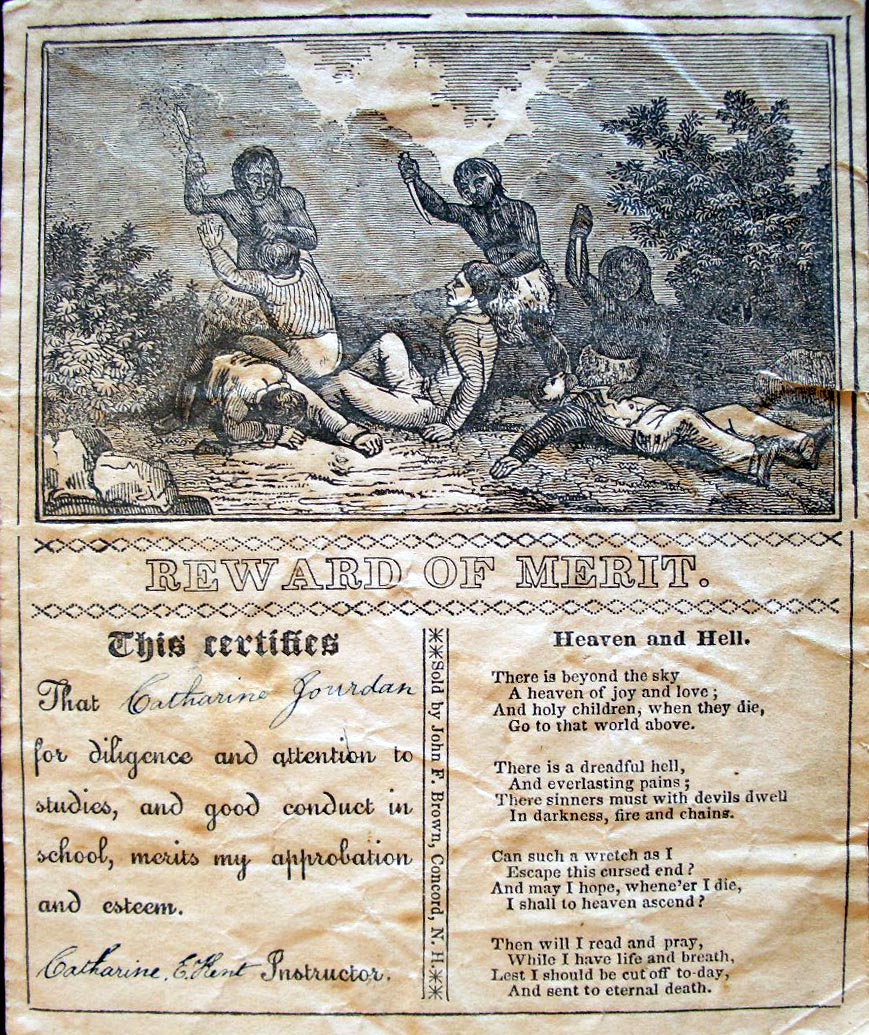
gold star for settler colonialist paranoia

American culture really hurts my brain sometimes. Imagine poor Catherine Jourdan getting this as a reward for her academic labor.

From Princeton Library's collection of Awards of Merits from the 1820s onward - not sure exactly of the date for this one. Less pedagogically twisted examples here.

Saturday, June 4, 2011

flipper, we are not in san diego anymore

Another military animal story: this time a photo essay at Mother Jones. Some of the images are quite surreal. As is the final quote in the caption below. I guess we all have different opinions of what San Diego is like?

"like ghosts, dogs are enigmas"

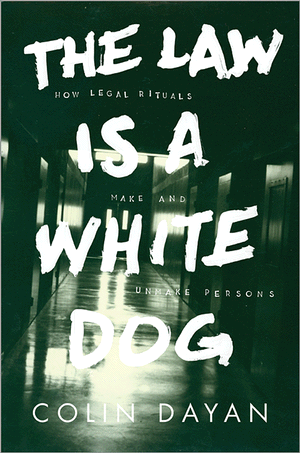
I'm posting what I hope will be the first of a few passages from Colin Dayan's engrossing new book The Law is a White Dog (chapter 1 available for download).

Dayan's dogs are quite a different lot from the flak-jacketed K9's that have been in the news of late, or the progressive modern pets that grace the pages of the Bark. In this book we find dogs in the company of slaves, prisoners, and detainees - "extraneous persons" on the precipice between being subjects and being nothing. Here we find canis familiaris outside the ideological safe house of sentimental (or, for that matter, military) domesticity...
Howling through the shadows at Hecate’s crossroads, sitting at Pontius Pilate’s feet, snarling at Jesus crucified, or accompanying the souls of the dead to the other side, dogs inhabit both divine and demonic realms. Like ghosts, dogs are enigmas. So speaks Nietzsche’s Zarathustra, haunted by his own thoughts:

Then, suddenly, I heard a dog howl nearby.
Had I ever heard a dog howl like this? My thoughts raced back. Yes! When I was a child, in my most distant childhood:
—then did I hear a dog howl like this. And I saw it too, bristling, its head up, trembling in the stillest midnight when even dogs believe in ghosts.


Ghosts like dogs are drawn to the familiar, the everyday, even as they tend toward the paranormal and supernatural. They appear as if somewhere between the real and supernatural, returning as a nightmare white phantom, a silent shade, or heavy with flesh, overripe and in need. In the meeting of the actual and the imaginary, ghosts and dogs bear down on the world of social relations and morality. Dogs and ghosts constantly cross boundaries, visit what they coveted most in life, counting on the heaviness of things to give them pleasure, to make them grieve. Ultimately, no matter how much they suggest the impalpable or transcendent, ghosts always come in bodies. They never obey the command to be wisps of air, some kind of steam, wet in the night or voices on the wind. (pp 15-16)
See also: this previous post on pit bulls and Dayan's essay "The Dogs"

Monday, May 30, 2011

war animals, finny and furry

A while ago I started a "military animal" bibliography on Zotero to share with a friend who's also interested in the social and cultural studies of dogs. It's definitely dog-heavy, though crows and camels also put in cameos. Most of the items are news stories from the past few years (lots of Bin Laden commando dog stuff of late). Here are a couple gems I've added recently. The first is more humorous ephemera, the latter, less so.

i. WWII submarine insignia
Via All My Eyes: "Due to the stealth nature of submarines, a logo is not displayed on the vessel itself, but it is printed on stationery, made into jacket patches, mess hall items, and home-port flags."


ii. K-9 Storm
Via Amaki09's Tumblr (click images for direct links). Google K9 Storm for more.

Monday, May 23, 2011

the weirdest people in the world?


WEIRD as in Western, Educated, Industrialized, Rich, Democratic.

I'm so excited about this acronym, I'll readily admit to not having read the source article yet! Here's the abstract by psychologists Joe Henrich, Steven J. Heine, and Ara Norenzayan of the University of British Columbia:
Behavioral scientists routinely publish broad claims about human psychology and behavior in the world’s top journals based on samples drawn entirely from Western, Educated, Industrialized, Rich and Democratic (WEIRD) societies. Researchers - often implicitly - assume that either there is little variation across human populations, or that these “standard subjects” are as representative of the species as any other population. Are these assumptions justified? Here, our review of the comparative database from across the behavioral sciences suggests both that there is substantial variability in experimental results across populations and that WEIRD subjects are particularly unusual compared with the rest of the species - frequent outliers. The domains reviewed include visual perception, fairness, cooperation, spatial reasoning, categorization and inferential induction, moral reasoning, reasoning styles, self-concepts and related motivations, and the heritability of IQ. The findings suggest that members of WEIRD societies, including young children, are among the least representative populations one could find for generalizing about humans. Many of these findings involve domains that are associated with fundamental aspects of psychology, motivation, and behavior - hence, there are no obvious a priori grounds for claiming that a particular behavioral phenomenon is universal based on sampling from a single subpopulation. Overall, these empirical patterns suggests that we need to be less cavalier in addressing questions of human nature on the basis of data drawn from this particularly thin, and rather unusual, slice of humanity. We close by proposing ways to structurally re‐organize the behavioral sciences to best tackle these challenges.
Found via Andrew Goldstone's "Race, Ethnicity, Brains" - which is in turn a response to this really intriguing "fairy tale" on cultural neuroscience by Paula Moya. Goldstone and Moya both teach at Stanford.

* Image: inspired illustration of Henrich, Heine, Norenzayan's research by Only Dead Fish.

Saturday, May 21, 2011

paperwork explosion (1967)


This is one of the most frightening depictions of technology and work life I've ever seen. Even though it's supposed to be selling a new labor-saving office product. For IBM no less. And it's made by Jim Henson. Vertigo-inducing, yes.

I came upon it via this blog post by the media historian Ben Kafka (not sure of relations to Franz - either way how could he not be interested in paperwork??) The film has a frenzied incantatory quality that Kafka captures perfectly here: 
The voices continue to explain the various features and benefits of IBM office equipment: cordless dictation,  error-free copy, improved typography, increased productivity. “IBM machines can do the work — so that people have time to think — machines should do the work — that’s what they’re best at — people should do the thinking — that’s what they’re best at.” Once again the music accelerates as a series of faces and voices speed across the screen: “Machines should work — people should think — machines — should work — people — should think — machines — should — work — people — should — think.”
Because, god knows, THEY HAVE A PLAN.

Thursday, May 19, 2011

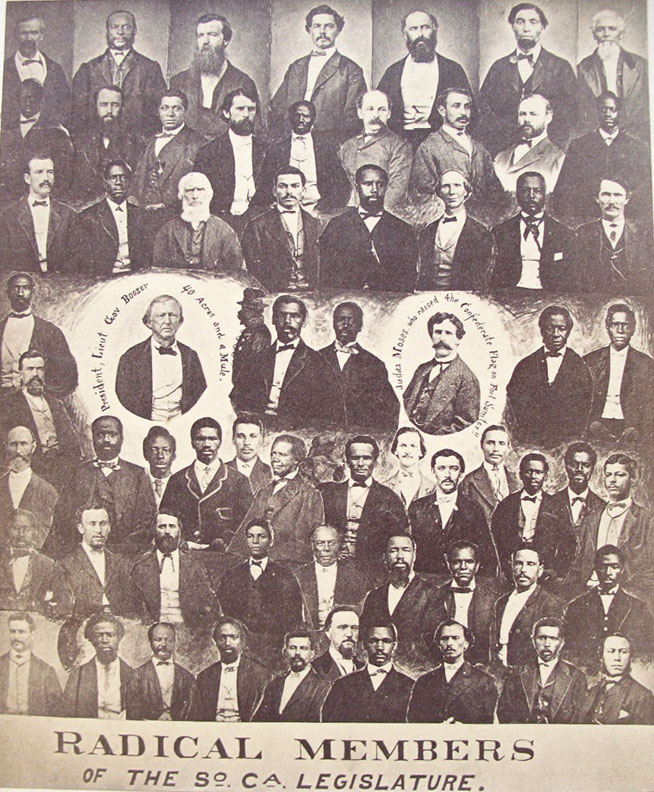
fear of a black senate; or, birtherism, 1868

From Princeton's Graphic Arts blog:
The composite image [racist text not shown - quoted below] documents the implementation of the Reconstruction Act of 1867, which redesigned the governing bodies of the southern states after the American Civil War. Not only did African Americans have the right to vote, but also serve within the government. When South Carolina rejoined the Union in 1868, they had the first state legislature with a black majority.

Created to frighten the white population, this image was widely distributed in many sizes and formats. One of our copies includes the text: These are the photographs of 63 members of the reconstructed South Carolina Legislature, 50 of whom are negroes or mulattoes and 13 white. 22 read and write (8 grammatically), the remainder (41) make their mark with the aid of an amanuensis. Nineteen (19) are tax-payers to an aggregate amount of $146.10, the rest (44) pay no taxes, and the body levies on the white people of the State for $4,000.00.

Wednesday, May 18, 2011

quick notes: deadly dualisms

Kim TallBear, opening comments at the "Why the Animal? Queer Animalities, Indigenous Naturecultures, and Critical Race Approaches to Animal Studies" symposium (April 12th, 2011):
[The symposium speakers'] critical approaches make the link between dualisms and the relegation of certain humans to the realm of less-than-human, to the realm of the animal. Violence against animals is linked to violence against particular humans who have historically been linked to animality. There are real implications... for who and what gets to live, and who and what gets to die when the human/animal split is made.

Tuesday, May 17, 2011

being hunted

{ I }
Val Plumwood, "Being Prey," 1995 (reprinted in the Utne Reader as "Surviving a Crocodile Attack" in 2000)*:
It seems to me that in the human supremacist culture of the West there is a strong effort to deny that we humans are also animals positioned in the food chain. This denial that we ourselves are food for others is reflected in many aspects of our death and burial practices—the strong coffin, conventionally buried well below the level of soil fauna activity, and the slab over the grave to prevent any other thing from digging us up, keeps the Western human body from becoming food for other species. Horror movies and stories also reflect this deep-seated dread of becoming food for other forms of life: Horror is the wormy corpse, vampires sucking blood, and alien monsters eating humans. Horror and outrage usually greet stories of other species eating humans. Even being nibbled by leeches, sand flies, and mosquitoes can stir various levels of hysteria.
This concept of human identity positions humans outside and above the food chain, not as part of the feast in a chain of reciprocity but as external manipulators and masters of it: Animals can be our food, but we can never be their food. The outrage we experience at the idea of a human being eaten is certainly not what we experience at the idea of animals as food. The idea of human prey threatens the dualistic vision of human mastery in which we humans manipulate nature from outside, as predators but never prey. We may daily consume other animals by the billions, but we ourselves cannot be food for worms and certainly not meat for crocodiles. This is one reason why we now treat so inhumanely the animals we make our food, for we cannot imagine ourselves similarly positioned as food. We act as if we live in a separate realm of culture in which we are never food, while other animals inhabit a different world of nature in which they are no more than food, and their lives can be utterly distorted in the service of this end.
Before the encounter, it was as if I saw the whole universe as framed by my own narrative, as though the two were joined perfectly and seamlessly together. As my own narrative and the larger story were ripped apart, I glimpsed a shockingly indifferent world in which I had no more significance than any other edible being. The thought, This can't be happening to me, I'm a human being. I am more than just food! was one component of my terminal incredulity. It was a shocking reduction, from a complex human being to a mere piece of meat. Reflection has persuaded me that not just humans but any creature can make the same claim to be more than just food. We are edible, but we are also much more than edible. Respectful, ecological eating must recognize both of these things. I was a vegetarian at the time of my encounter with the crocodile, and remain one today. This is not because I think predation itself is demonic and impure, but because I object to the reduction of animal lives in factory farming systems that treat them as living meat.

{ II }

Not being prey is not always a sure thing for humans - not all humans anyway - in Western history. In New World slavery, for example, one can be meat for animals without necessarily being food. Or perhaps the correct word is flesh? Among other hideous things, racism is a system which has historically made some people's flesh subject to animal violence.

{ III }
Dog bite genealogy: more images along this vein I've been collecting over at Tumblr.

- - -

* Plumwood's memorial website has a Word version of this essay, which is how I first read it. But the file ended up crashing my computer - so avoid it!

publish, perish - or phish

Surprised they didn't ask for your social and bank account number too!

Saturday, April 30, 2011

"you're fired"; or, the grotesque cog of power

Michel Foucault on "grotesque sovereignty" in the West (source):
Political power, at least in some societies, and anyway in our society, can give itself, and has actually given itself, the possibility of conveying its effects and, even more, of finding their source, in a place that is manifestly, explicitly, and readily discredited as odious, despicable, or ridiculous.
This grotesque mechanism of power, or this grotesque cog in the mechanism of power, has a long history in the structures and political functioning of our societies. There are striking examples of it in Roman history, especially in the history of the Roman Empire, where the almost theatrical disqualification of the origin of power in, and the coupling of every effect of power with, the person of the emperor was precisely a mode, if not of governing exactly, at least of domination: a disqualification that ensured that the person who possessed maiestas, that is to say, more power than any other power was, at the same time, in his person, his character, and his physical reality, in his costume, his gestures, his body, his sexuality and his way of life, a despicable, grotesque, and ridiculous individual.
We know that ethnologists... have clearly identified the phenomenon in which the person to whom power is given is at the same time ridiculed or made abject or shown in an unfavorable light, through a number of rites and ceremonies. Is this a case of a ritual for limiting the effects of power in archaic or primitive societies? Perhaps.
However, I would say that if these rituals still exist in our societies, their function is completely different. I do not think that explicitly showing power to be abject, despicable, Ubu-esqu or simply ridiculous is a way of limiting its effects and of magically dethroning the person to whom one gives the crown.
Rather, it seems to me to be a way of giving a striking form of expression to the unavoidability, the inevitability of power, which can function in its full rigor and at the extreme point of its rationality even when in the hands of someone who is effectively discredited.

Wednesday, April 27, 2011

word cloud #2: domestications, multispecies resettlement, barbarians

Another "words (and ideas) that caught my attention" post, apropos of the "origins of human rule" from entry #1 below. Here are the titles of a set of upcoming lectures at Harvard by the the political anthropologist James Scott:
Four Domestications: Fire, Plants, Animals and… Us

The Late Neolithic Multi-Species Resettlement Camp

The Long Golden Age of Barbarians, a.k.a. Non-State Peoples
Which reminds me, I need to read James Scott!

word cloud #1: human rule, before present

Almost everyday I come across interesting turns of phrase or figures of thought that make me pause and think: "oh, I should jot this down somewhere." So I'm going to start collecting them here. This will also double as a public bookmarking system since, more often than not, I won't actually have had the chance to study the source of the phrase yet.

My first two entries are from the "Ghost Metropolis: Los Angeles since 13,000" mapping project at Hypercities. I don't know enough about either to explain what they are, so I won't fake it. But I do plan to read through the "Ghost Metropolis" materials, a crazy ambitious history of (what we now know as) L.A. In the course of skimming through the first couple screens these phrases wormed their way into my brain:

1. The Origins of Human Rule of Southern California: which, I learned, began "13.1 to 13 thousand calendar years BP" on Santa Rosa, one of the Channel Islands (when you click on the geolocate button  you swoop in from an outerspace view of the planet earth to this reedy blue dot on a desolate virtual landscape. It's not so much breath-taking as heart-breaking). But to the point: what struck me is this phrase "human rule." Not (just) "human presence," but "rule." I'm intrigued with the idea of politicizing early human life through a multispecies frame. More on this another time.

2. BP / Before Present: I noticed that the "13,000" in the project title doesn't have "BCE" or the old-fashioned "BC" attached. In the body of the text I came across this curious (and perhaps unfortunate) abbreviation, BP. Trusty wikipedia tells me this means "before present." But evidently this present, among the scientists who use this time scale notation system, is not the present per se - but 1950, the point at which modern carbon-dating methods became standard.
     There's a certain shabby beauty in the idea that 1950 somehow constitutes an eternal now (though Wikipedia further informs me that "to account for the concern that the year 1950 has by now moved away from the present significantly, the abbreviation BP has also been re-interpreted to mean Before Physics.") But I wish the idea is as relativistic as the term BP implies. That rather than being a series of fixed points, the past is always relative to the present, always on the move.

Saturday, April 23, 2011

micro-cross-blogging: barely verbal

Maybe it's a nano-addiction that will pass, but I've spent a fair amount of time lately on my tumblr Village Dog. Mostly, I just post pictures there. Here are a few very short bits of writing I've done over yonder (linking to them here because, quaint as it may seem, I think of this as a my writing outpost):
And finally:
  • Barely verbal, an image-essay on pictograms, miniatures, and representing the unrepresentable in the post-Katrina world of New Orleans artist Bruce Davenport, Jr.  

    Wednesday, March 9, 2011

    dialectics of domestication

    An interesting Radiolab piece with evolutionary biologist Brian Hare on Russian geneticist Dmitri Belyaev's celebrated silver fox domestication experiment. Belyaev's foxes have gotten a fair amount of play in popular media - as a part of the origin story of dogs. (Here's something I'm starting to think about: the canids who make dogs dogs, so that dogs can, as the saying goes, make us human. Another example would be the captive wolves, human-raised or not, who stand in as the foil of dogs in studies of social cognition, for example these by Brian Hare.)

    What I found most striking about the RadioLab version of the story: the cartoonish, disturbingly repetitive gun shot sound effects that point up the role of culling in selective breeding (plus, these foxes were raised for fur in the first place...)

    Related posts on free-range dogs and undesireable dogs.


    Image courtesy of http://www.gmilburn.ca/

    Note: I tried posting an earlier version of this on Village Dog, my Tumblr experiment, but had some technical difficulties. It seems to fit better here, anyway.